
Why Lord Ganesha Is Worshipped Before Every Auspicious Occasion
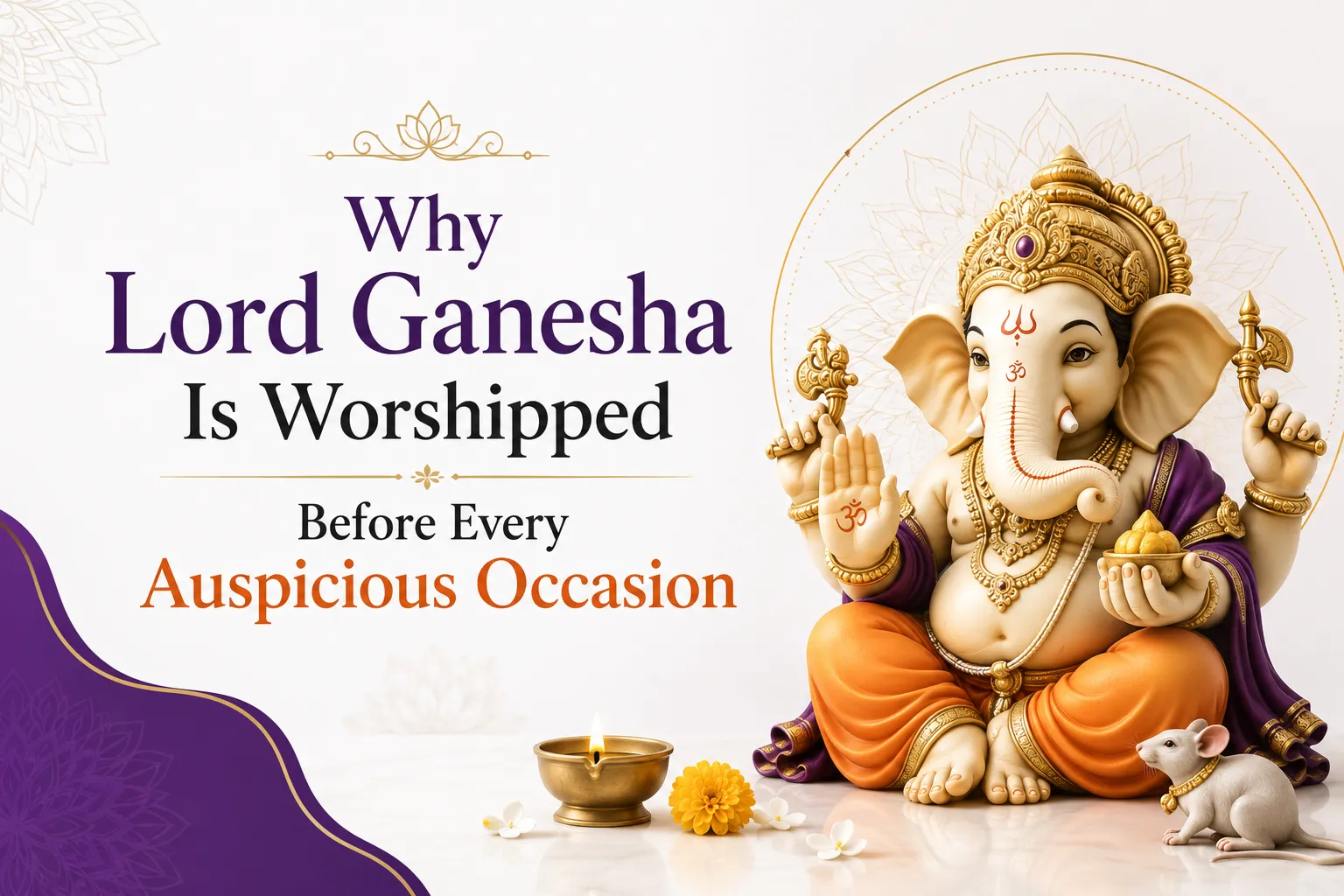
Why is Lord Ganesha worshipped before every auspicious occasion? He holds the title Pratham Pujya — the first to be worshipped — granted by Lord Shiva himself. Here are the Puranic stories behind it, the meaning of his titles like Vighnaharta and Mangal Murti, and where Ganesh Puja appears in weddings, naming ceremonies and every other Hindu function.
Why Lord Ganesha Is Worshipped Before Every Auspicious Occasion
The stories, the titles, and the reason no Hindu ceremony begins without him.
Walk into any Hindu wedding, naming ceremony, housewarming or shop inauguration, and the first thing that happens, before the havan, before the vows, before the guests settle, is a prayer to Lord Ganesha. It isn't optional or decorative. It is the rule, and it has been for a very long time. Here is why.
Quick answer
Lord Ganesha holds the title Pratham Pujya, the first to be worshipped. According to the Shiva Purana, this boon was granted by Lord Shiva after Ganesha demonstrated that wisdom outweighs speed. As Vighnaharta, the remover of obstacles, invoking him first clears the path for any ceremony or new beginning to proceed without hindrance.
The Story That Settled It
The Race Around the World
The most widely told version goes like this. A celestial fruit arrived at Kailash, and both sons, Ganesha and Kartikeya, wanted it. Shiva set the contest: whoever circled the entire world first would receive the fruit and the honour of being worshipped before all other gods.
Kartikeya left at once. He mounted his peacock and flew around the earth, covering continents and oceans. Ganesha stayed put. He walked calmly around his parents, Shiva and Parvati, folded his hands and said: you are my world. Everything I know, everything I come from, begins and ends with you.
Shiva smiled, gave him the fruit, and granted him the boon of Pratham Pujya. From that day, no Hindu ceremony could begin without invoking Ganesha first. The lesson wasn't lost on anyone: devotion and understanding can outrun even the fastest traveller.
The Curse That Reinforced It
There is a second, lesser-known story. Once, a group of devas performed a yagna but forgot to invoke Ganesha at the start. The yagna ran into one obstacle after another: the fire wouldn't catch, the offerings scattered, nothing went right. Ganesha appeared, not out of anger but to make a point: any auspicious act begun without the remover of obstacles will meet exactly that, obstacles. The devas corrected their error, the yagna succeeded, and the rule was reaffirmed. It's a practical story, almost like a warning built into the tradition so nobody skips the step again.
What His Titles Tell You
Each of Ganesha's names carries a reason, and together they explain why he opens every ceremony:
Where You See It in Practice
Ganesh Puja or Ganesh Sthapana is the first ritual at nearly every Hindu function:
- Weddings. The wedding mandap is set up with a Ganesh idol or image at the front, and the Ganesh Puja precedes every other ritual, from the haldi to the pheras.
- Engagements. The sagai opens with a Ganesh Vandana, asking for blessings on the match.
- Baby showers. A Godh Bharai or Dohale Jevan begins with a brief Ganesh puja for the health of the mother and child.
- Naming ceremonies. The Namkaran starts with Punyahavachan, and within it, Ganesha is invoked first to bless the baby's new identity.
- Housewarmings. At a Griha Pravesh, the first thing to enter the new home after the threshold ritual is the Ganesh idol.
- New ventures. Opening a shop, starting a business, buying a vehicle, even sitting for an exam: a short Ganesh prayer is the common thread across all of them.
The pattern is consistent enough that it has become instinctive. Most families don't think about why they do it anymore; they just do. But the reasoning, that you clear the obstacles before you begin the journey, is sound enough to have lasted millennia.
Why It Still Matters
Strip away the theology and what you're left with is a habit of pausing before you start. Of asking for help with the things that might go wrong. Of honouring your parents and your origins before you rush off to circle the globe. Ganesha sits at the start of every ceremony because beginnings shape everything that follows, and a beginning done with care, humility and a cleared path has a better chance of ending well. That's not just religious belief. It's common sense dressed in a prayer.
Starting an Auspicious Occasion?
Every ceremony begins with Ganesha, and every guest list begins with an invite. We design custom digital and video invitations for weddings, engagements, baby showers, naming ceremonies, housewarmings and puja events. From ₹199, delivered on WhatsApp.
Frequently Asked Questions
Why is Lord Ganesha worshipped before every auspicious occasion?
He holds the title Pratham Pujya (first to be worshipped), a boon granted by Lord Shiva. As Vighnaharta (remover of obstacles), invoking him first clears the path for any ceremony or new beginning to proceed without hindrance.
Which story explains why Ganesha is worshipped first?
In the Shiva Purana, Shiva set a challenge for Ganesha and Kartikeya to circle the world. Kartikeya flew around the earth, but Ganesha walked around his parents, saying they were his entire world. Pleased, Shiva granted him the boon of being worshipped before all other gods.
What does Vighnaharta mean?
Vighnaharta means "remover of obstacles." It is one of Lord Ganesha's principal titles and the core reason he is invoked at the start of any ceremony, journey, exam or new venture.
Is Ganesh Puja done before a wedding?
Yes. Every Hindu wedding begins with a Ganesh Puja or Ganesh Sthapana, invoking Lord Ganesha to bless the ceremony and remove obstacles. The same applies to engagements, baby showers, naming ceremonies and housewarmings.
What are the main titles of Lord Ganesha?
Key titles include Vighnaharta (remover of obstacles), Pratham Pujya (first to be worshipped), Mangal Murti (embodiment of auspiciousness), Ganapati (lord of the ganas), Lambodara (the large-bellied, symbolising generosity) and Ekadanta (single-tusked, symbolising sacrifice).
Where can I get an invitation for an auspicious occasion?
Daily Branding Invites designs custom digital and video invitations for weddings, engagements, baby showers, naming ceremonies, housewarmings and puja events from ₹199, delivered on WhatsApp, Instagram and email.